Mapping Climatic Influences on Victory Patterns in Outdoor Tennis Grand Slams and Seasonal Horse Racing Events
Gisela Berger · Sep 27, 2026
Mapping Climatic Influences on Victory Patterns in Outdoor Tennis Grand Slams and Seasonal Horse Racing Events
Climatic conditions shape outcomes in outdoor tennis grand slams and seasonal horse racing events through measurable effects on player endurance, equipment performance, and track surfaces. Researchers compile data from multiple decades to identify consistent correlations between temperature ranges, humidity levels, wind speeds, and rainfall totals with win rates for specific competitors and equine athletes. Observers note that venues experience distinct seasonal weather profiles, which create repeatable advantages for athletes adapted to those conditions.
Tennis Grand Slams and Regional Climate Profiles
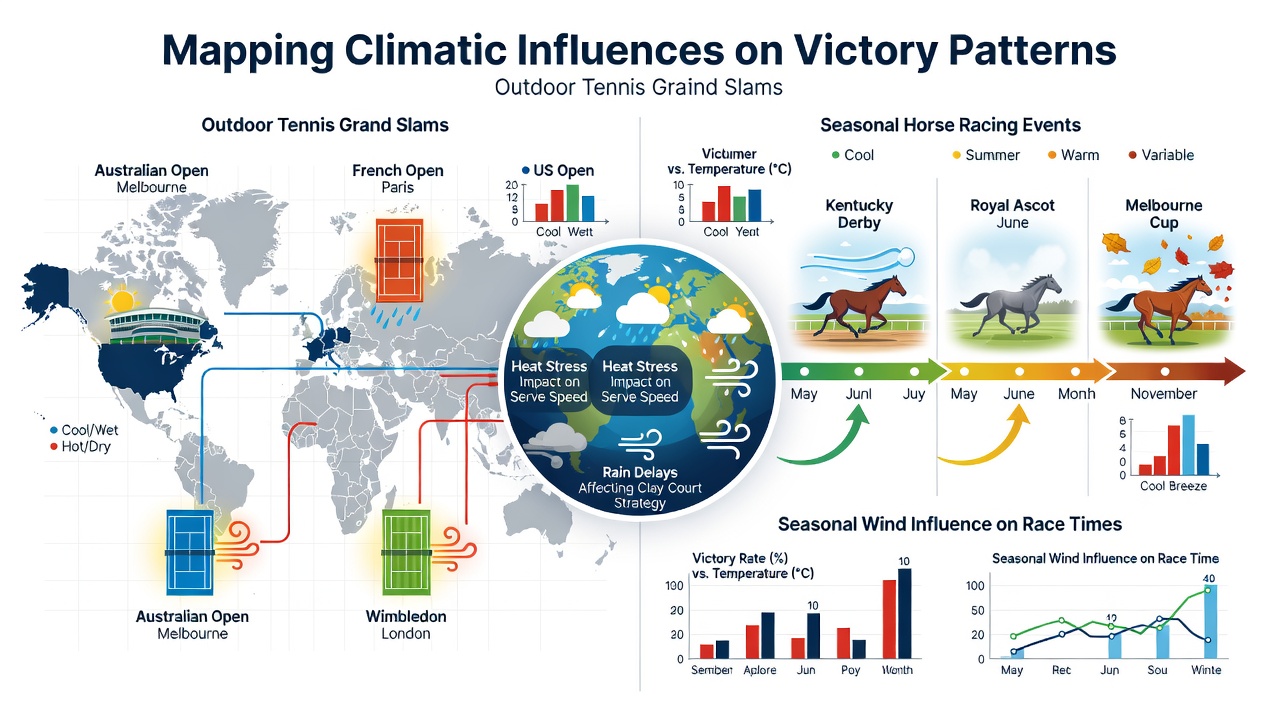
The Australian Open occurs during peak summer heat in Melbourne, where daytime temperatures often exceed 30 degrees Celsius and high humidity accelerates fatigue in extended matches. Data from past tournaments shows that players with superior heat acclimatization records secure higher percentages of victories in later rounds. The French Open at Roland Garros features variable spring conditions in Paris, including occasional heavy showers that slow clay courts and alter ball bounce patterns, leading to shifts in rally lengths that favor baseline specialists over serve-dominant styles.
Wimbledon takes place on grass courts in London during early summer, when intermittent rain can interrupt play and change surface moisture levels. Historical records indicate that matches resuming after precipitation see measurable drops in serve accuracy for some competitors. The US Open in New York concludes the calendar in late summer, with a combination of heat and humidity that researchers link to increased rates of unforced errors in afternoon sessions. As preparations advance for the 2026 edition scheduled in September, analysts continue to track long-term humidity trends at Flushing Meadows to refine performance models.
Seasonal Horse Racing Events and Track Condition Variables
Horse racing calendars align with regional weather cycles, producing distinct victory distributions across spring, summer, and autumn meets. Spring fixtures in temperate zones often encounter softer ground from residual winter moisture, which studies associate with improved results for horses possessing greater stamina profiles. Summer events on firmer turf correlate with faster times and higher win frequencies for speed-oriented runners when temperatures remain moderate.
Autumn meetings introduce cooler air and variable rainfall that compact racing surfaces differently, influencing stride lengths and energy expenditure. Meteorological records from major tracks demonstrate that precipitation amounts above certain thresholds shift favorite outcomes toward horses with proven wet-track experience. These patterns emerge across multiple jurisdictions when data sets aggregate results over twenty-year spans.
Integrated Data Mapping Approaches
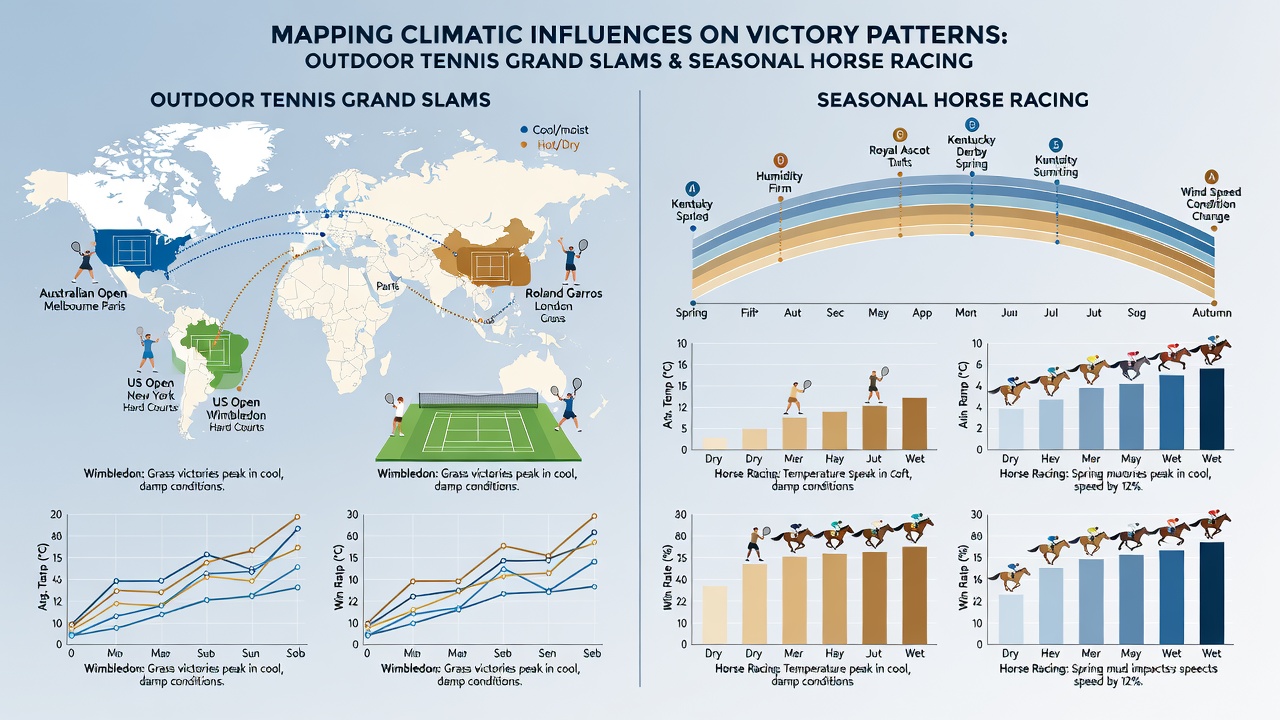
Analysts combine meteorological archives with competition results to generate spatial models that highlight climate-driven victory clusters. Temperature thresholds above 28 degrees Celsius appear repeatedly in datasets as points where certain tennis players exhibit elevated win probabilities, while wind speeds exceeding 15 kilometers per hour show inverse relationships with first-serve percentages. In horse racing, ground condition indices derived from rainfall totals predict changes in finishing order distributions with statistical significance across multiple seasons.
Cross-sport comparisons reveal overlapping mechanisms, such as the impact of elevated humidity on both human recovery times and equine respiratory efficiency. Institutions including the Australian Bureau of Meteorology supply localized datasets that feed these mapping exercises, while research from European weather services adds comparative layers for northern hemisphere venues. The resulting visualizations allow pattern recognition without reliance on single-event anomalies.
Long-Term Trends and Venue Adaptations
Decadal climate records indicate gradual shifts in average temperatures and precipitation timing at established venues. These changes coincide with adjustments in scheduling and surface maintenance protocols that aim to stabilize playing conditions. Tennis organizers have documented modifications to court watering schedules and shade structures in response to observed heat stress indicators, while racing authorities monitor track drainage systems to manage increased rainfall variability.
Performance databases continue to expand as new seasons add data points. Patterns identified in earlier decades remain detectable in recent results, suggesting that core climatic influences persist even as baseline averages evolve. Mapping exercises therefore incorporate both historical baselines and updated readings to maintain accuracy in projections.
Conclusion
Climatic mapping of victory patterns across tennis grand slams and seasonal horse racing events relies on integrated environmental and performance datasets. Consistent correlations emerge between specific weather parameters and outcome distributions when researchers examine aggregated records from multiple venues and years. These factual relationships support ongoing analysis as conditions continue to fluctuate seasonally.